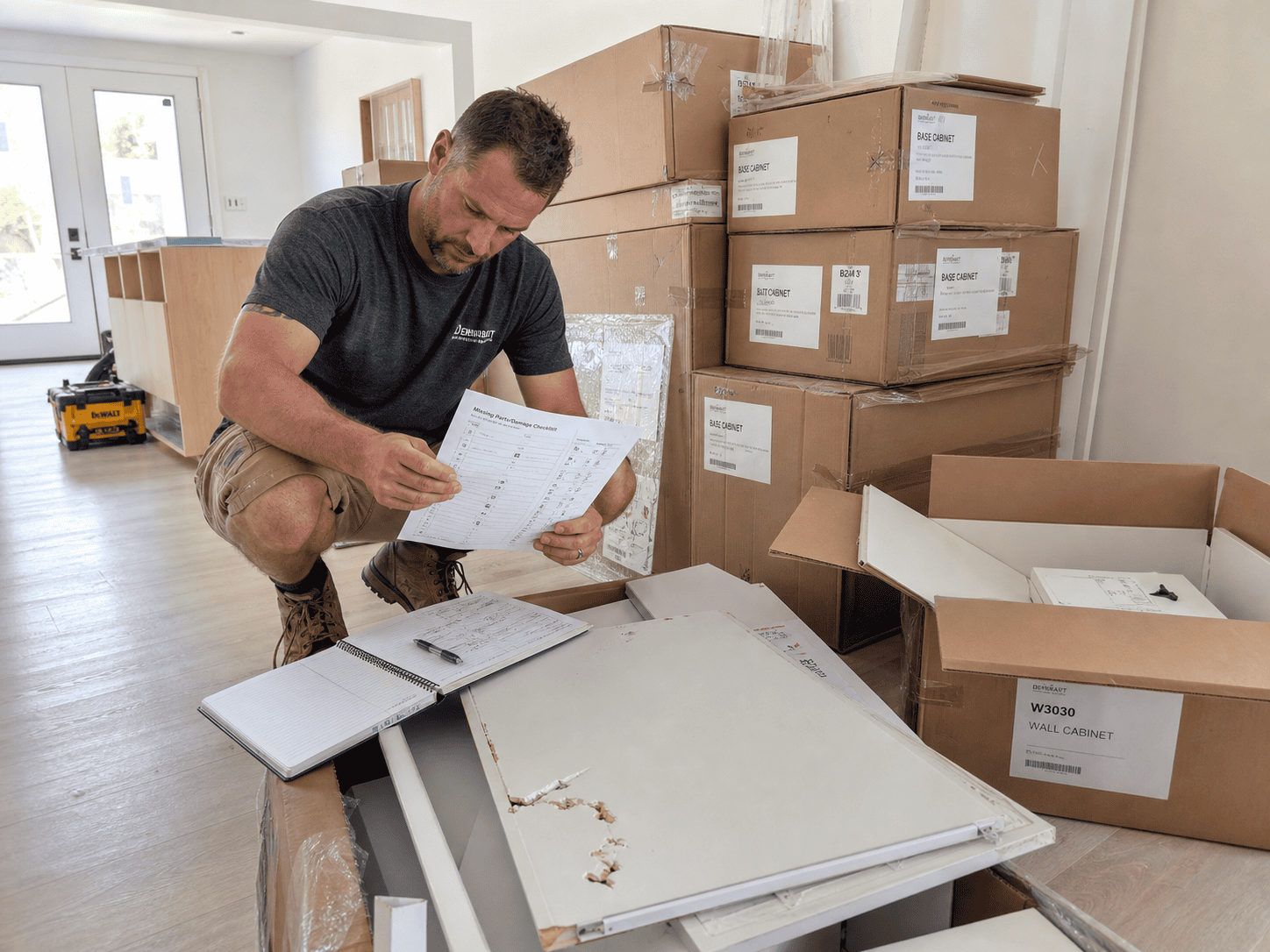
What Happens If Cabinet Parts Arrive Missing or Damaged?
One of the biggest concerns in custom cabinet projects, especially overseas orders, is simple:
What happens if some cabinet parts arrive missing or damaged?
This is a reasonable concern.
Cabinet projects involve many parts, multiple stages of handling, and coordination between production, packing, shipping, unloading, and installation. Even with careful preparation, clients still want to know what happens if something is not right when the goods arrive.
A professional project should not treat this question as an exception.
It should have a clear response process.
In this guide, we explain what usually happens when cabinet parts arrive missing or damaged, and why a defined handling process matters so much.
Why this issue matters in cabinet projects
Custom cabinet projects are not like buying one simple product in one box.
A project may include:
- multiple cabinet sections
- panels, doors, and fillers
- hardware and accessories
- labeled packages by area
- installation-dependent components
- coordinated sets across kitchens, wardrobes, vanities, or storage walls
That means missing or damaged parts can affect not only one item, but also the installation sequence and project timing.
This is why the response process matters just as much as the original production quality.
1. The first step is to identify the issue clearly
When goods arrive, the first priority is not panic. It is clarity.
If a part is missing or damaged, the problem should be identified as specifically as possible.
That usually means confirming:
- which package or area the issue relates to
- whether the item is actually missing or simply not yet unpacked
- whether the issue affects installation immediately or later
- whether the damage is minor, visible, or structural
- whether the issue involves one part or multiple related parts
Clear identification helps prevent confusion and speeds up the next step.
2. Photos and videos are important for reporting
Visual evidence is one of the most useful tools in after-delivery handling.
Clients or installers should usually record:
- photos of the damaged part
- photos of the package label
- photos of the outer packaging if relevant
- videos of unpacking if the issue is discovered during opening
- a clear view of where the part belongs if that helps explain the issue
Good documentation helps both sides understand the problem faster.
It also helps separate different possibilities, such as shipping damage, unpacking damage, missing-package confusion, or part-identification issues.
3. Part labels and packing logic make issue tracking easier
A well-organized project should not depend only on memory when something goes wrong.
This is why labeling and packing structure matter so much.
If the project is organized clearly, it is easier to trace:
- which area the missing or damaged part belongs to
- whether the issue came from packing, transport, or installation-stage handling
- whether related parts are also affected
- how urgently the issue needs to be resolved
Strong labeling does not prevent every issue, but it makes the response much faster and more accurate.
4. The issue should be reviewed before deciding the solution
Not every problem requires the same response.
Once the issue is documented, the next step is to review:
- what the part is
- how serious the damage is
- whether the part is essential for installation
- whether the issue can be solved locally
- whether a replacement is necessary
- how urgently the replacement is needed
For example, a small cosmetic issue may be handled differently from a damaged structural panel or a missing door for a completed cabinet section.
5. Some issues can be handled locally, others need replacement parts
In real projects, solutions may vary.
Depending on the problem, handling may involve:
- confirming the correct part location if there was unpacking confusion
- identifying whether the part was grouped in another package
- using a local adjustment if the issue is minor and acceptable
- arranging replacement parts if the problem cannot be reasonably solved on site
The most important point is not pretending every issue is the same.
A good response process should fit the actual problem.
6. Replacement handling should be clear and practical
When replacement parts are needed, clients usually want answers to these questions:
- what exactly will be remade or resent
- how quickly the replacement can be prepared
- what information is needed to confirm it
- whether shipping arrangements will differ from the main shipment
- how the replacement will affect installation timing
Clarity matters here because uncertainty creates more frustration than the problem itself.
Even when an issue cannot be solved instantly, a clear handling path gives the client more confidence.
7. Responsibility should be understood realistically
This is another reason clients worry about missing or damaged parts.
They want to know:
Who is responsible?
In practice, the answer depends on the situation.
The issue may relate to:
- packing
- shipping damage
- unloading handling
- site handling
- installer handling
- unpacking mistakes
- communication or identification mistakes
That is why responsibility should be reviewed based on the actual situation, not assumed too quickly.
A serious supplier should help clarify the issue rather than avoiding the discussion.
8. Fast communication reduces installation disruption
When a problem is discovered, speed matters.
Not because every issue can be solved immediately, but because delayed communication often makes the installation impact worse.
A faster report helps:
- identify affected parts sooner
- decide whether installation can continue in other areas
- plan replacement or workaround options earlier
- reduce confusion between client, installer, and supplier
This is especially important in overseas projects where time zones and logistics already add complexity.
9. Good project closeout depends on after-delivery support too
A cabinet project is not truly complete when the goods are only delivered.
It is complete when the project can move through installation and closeout with reasonable clarity.
That is why after-delivery support matters.
A strong project response process should help clients handle:
- missing parts
- damaged parts
- part identification issues
- clarification during installation
- communication between site and supplier
- replacement coordination where needed
This is a major part of trust in export projects.
10. Prevention is still the best strategy
Even though problems can be handled, prevention is still better than correction.
That is why projects benefit from:
- clearer packing logic
- stronger labeling
- visual pre-shipment confirmation
- careful pre-assembly checks
- organized installation documentation
- timely communication during unpacking and installation
The better the project is prepared before shipment, the lower the risk of confusion later.
Common mistakes when issues are discovered
A few mistakes happen often:
Reporting the problem too vaguely
Saying “some parts are wrong” is much harder to act on than sending labeled photos and a specific explanation.
Throwing away packaging too early
Outer package condition may help explain whether damage happened before or after arrival.
Mixing missing-part issues with unpacking confusion
Sometimes the part is not missing; it is simply grouped elsewhere.
Waiting too long to report the issue
Delayed reporting can make review and responsibility tracking harder.
Letting installers improvise without confirmation
Unapproved fixes can create new problems later.
What clients should do when they find a problem
A practical first response usually includes:
- stop and identify the exact issue
- check labels and surrounding packages
- take clear photos and videos
- keep relevant packaging if possible
- report the issue with specific details
- confirm whether installation can continue in other sections
- wait for the agreed handling path before making major changes
These steps make the situation much easier to manage.
Final thoughts
Missing or damaged cabinet parts are one of the biggest concerns in custom export projects for a good reason.
What matters most is not pretending the risk never exists.
What matters is having a clear, organized way to identify, report, review, and resolve the issue if it happens.
At COZI Cabinet, a project should be supported not only through design and production, but also through after-delivery communication and practical problem handling when needed.